Own your VPN. No provider logs, no $12/mo.
SelfVPN deploys a private WireGuard server you control on a cloud provider of your choice. Your traffic never passes through a commercial VPN's logs — because there's no VPN company in the middle.
★★★★★ 5 / 5 Rating (From 1 user)
Support for 10+ cloud providers
Stop renting trust from a logging VPN provider. Own the server instead.


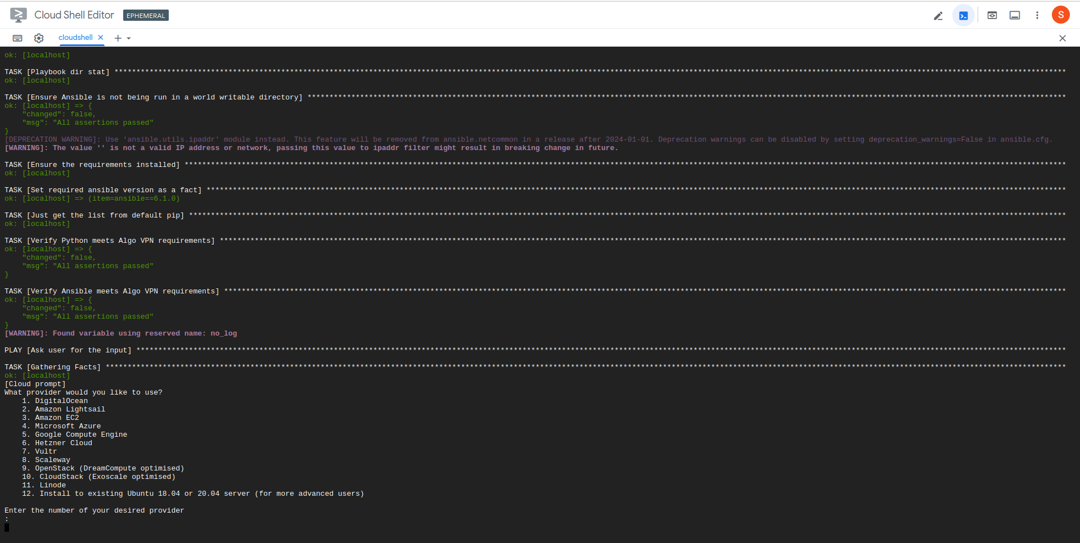
Cloud-shell environment
Pre-installed dependencies, everything set up to Just Work. You run one script; the VPN is yours.

WireGuard protocol, clients for every platform
The server runs on WireGuard — clients for iOS, Android, macOS, Windows, and Linux.
Built with security and ease-of-use in mind
Strong crypto: IKEv2 (AES-GCM, SHA2, P-256) for iOS/macOS/Linux
Auto-generated .conf files + QR codes for every platform
One-tap Apple profiles for iOS/macOS — no client app needed
Optional ad-blocking DNS resolver

Deploy your own VPN server with exclusive access and control.
It takes less than 15 minutes.
Why own your VPN server?
VPNs have become a requirement for many people to work and browse with a basic level of safety. But commercial VPN services simply shift your trust from your ISP to them.
Many VPN providers still record logs of their users — for analytics, billing, or because they were compelled to. As we've seen time and again, that metadata can be handed over and used to reconstruct your activity and identity. On top of that, you pay ~$12/month for shared "public" servers throttled by thousands of other users.
With cloud providers offering compute across geo-locations, it no longer makes sense to pay a specialized service for general resources with a thin software layer on top — especially when the engine (WireGuard) is free and open source.
SelfVPN lets anyone DIY their own VPN while keeping ownership and sovereignty of their data and identity.
The honest picture
SelfVPN gives you provider-level privacy: no commercial VPN sitting between you and the internet, logging your activity. It is not magic anonymity — your cloud host and ISP still see that your server exists and when it's active, and the websites you visit still see your server's IP. What they don't get is a third party's record of everywhere you went. For most people escaping the "we don't log you (wink)" VPN industry, that's the whole point.
Who this is for
- People done renting trust from logging VPN providers
- Privacy-conscious users who want ownership, not a subscription
- Anyone comfortable running a script in a cloud shell (AI assistants like ChatGPT or Claude can walk you through each step)